The basics: how do Italian tolls work?
Italy uses a closed toll system: at the entry ramp you pull a ticket (or your toll badge opens the barrier), and at the exit you pay based on the distance driven and vehicle class. On short stretches (around Milan or Naples) a flat per-plaza fee applies (sistema aperto). All tariffs are public through the operator Autostrade per l'Italia.
- Tolls depend on distance and vehicle class (A to 5) - a motorhome usually falls into class B.
- Typical price for a car: about €7 per 100 km on the A1 (Milan-Naples).
- Some northern tunnels (Mont Blanc, Fréjus, Grand St Bernard) carry a separate, high toll - do not use your Telepass there if you care about price.
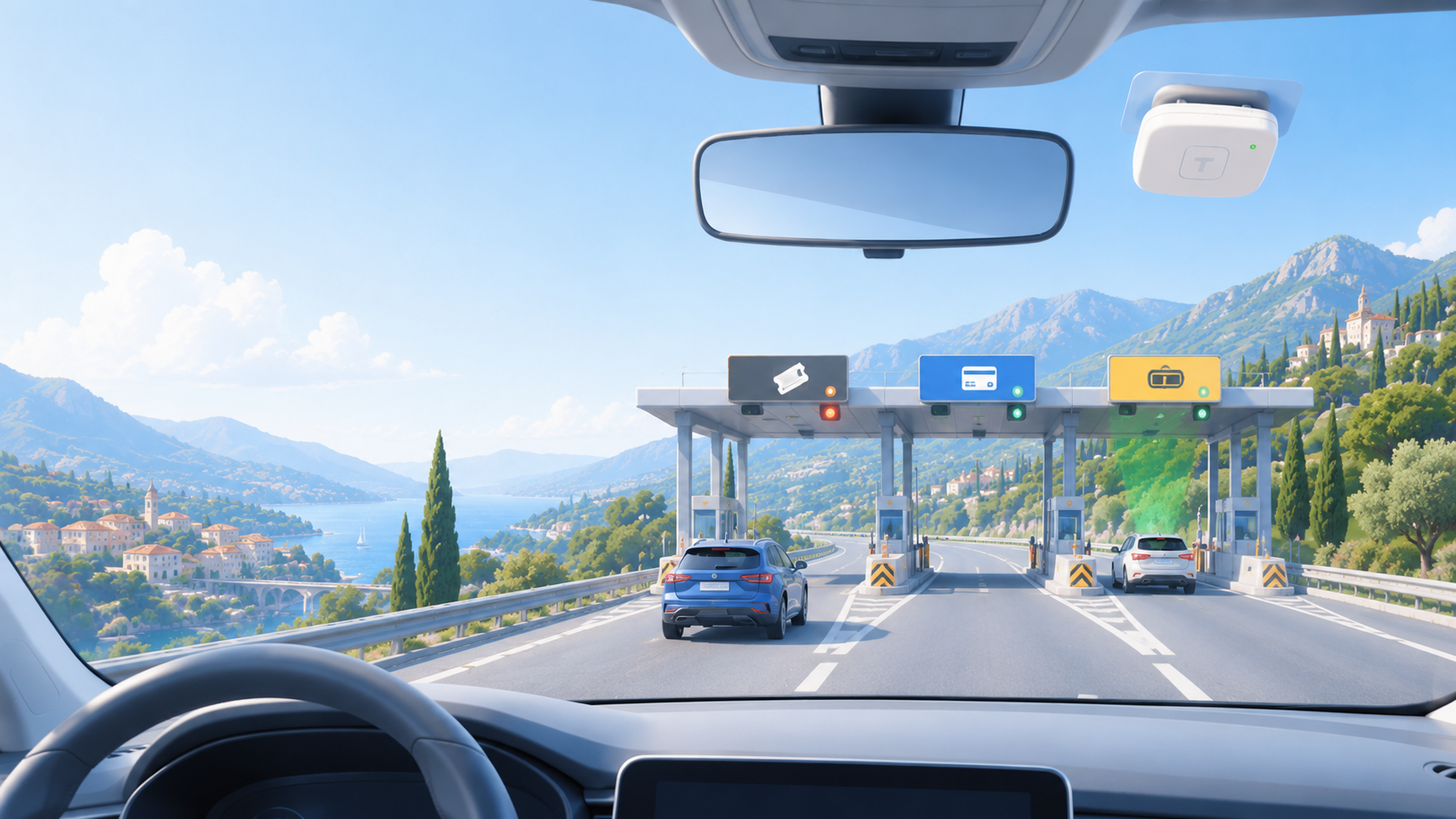
The lanes at the toll plaza - which colour do you take?
Every casello has several lanes. The colour above each lane tells you which payment methods are accepted. Pick the wrong lane and you may not be able to reverse - and you could face a fine.
For vehicles with a valid Telepass or a compatible European toll badge (Bip&Go, Fulli, Ulys, etc.). The barrier opens automatically - do not stop, keep rolling in first gear at up to 30 km/h.
For payment with a bank card or credit card (Visa, Mastercard, Maestro). Stop, insert the card, wait for confirmation and drive off. Newer terminals also accept contactless.
The classic self-service lane: stop and pay cash (euros, notes up to €50 accepted) or by card. Ideal if you don't have a toll badge. Carry coins - not every machine reliably gives change.
A combined lane with either an attendant or all payment methods. A green T on the sign means Telepass only. A T plus a card symbol means card or Telepass. When in doubt, take the white or mixed lane - you can always pay there.
Is a toll badge worth it for Italy?
A toll badge is not cheaper than paying yourself - once you factor in subscription and service fees it can even be slightly more expensive. The real gain is time and convenience: during peak holiday periods the queues at the white and blue lanes can, in the worst case, take up to 45 minutes to clear, while badge holders roll straight through the yellow lane.
Handy bonus: the same badge works in France, Spain and Portugal, and on most Italian city access points (ZTL Milan, paid parking, ferries).
Common mistakes at Italian toll plazas
- Losing the entry ticket - you then pay the maximum tariff for the whole motorway.
- Driving into the yellow Telepass lane without a working badge - fines run to €87 plus the toll itself.
- Assuming every terminal takes contactless - older plazas only take chip-and-PIN or cash.
- Booking a motorhome or caravan as a 'car' - it usually falls into class B and pays a higher rate.
- Tailgating the car in front into a Telepass lane - the barrier closes after a single vehicle.
Frequently asked questions
What if I've lost my toll ticket?
Report it to the attendant in a staffed lane, or press the intercom in the white lane. Without the ticket you pay the maximum tariff - unless you can prove where you entered the motorway (e.g. a fuel receipt or a photo).
Can I pay with a UK / EU debit card?
Yes, Visa, Mastercard and Maestro work on almost all blue (Viacard) lanes. Always carry a credit card as backup - Maestro isn't universally accepted in the south.
Does my French Bip&Go or Fulli badge work in Italy?
Yes, the European toll badge standard (EETS) is supported. Both Bip&Go and Fulli work in Italian Telepass lanes. Check that Italy is included in your subscription - it is sometimes a paid add-on.
Are there toll-free alternatives in Italy?
Yes: the strade statali (marked with SS numbers) are free, but much slower. Fine for short hops or avoiding jams; on long days to the Adriatic coast or Sicily the paid autostrada saves hours.
Ready for the trip?
Compare in a minute which toll badge is best value for your route to Italy - including transit through France or Switzerland.